How to Choose a Korean Sunscreen: SPF, PA, Skin Type & Texture Guide
Find your sunscreen match in 30 seconds — by skin type, texture and daily routine.
Start with the way you need it to wear.
Oily / Acne-Prone
Gel, fluid or lightweight essence
Finish: Fresh · Low shineDry / Dehydrated
Cream or moisturizing essence
Finish: Dewy · ComfortableSensitive / Reactive
Fragrance-free, simple formula
Priority: Patch test firstOutdoor / Sports
Water-resistant sunscreen
Priority: Reapply after sweat or waterSPF vs PA — What Each One Protects Against
- Protects mainly against UVB
- Think: sunburn
- Daily target: SPF 30–50
- Indicates UVA protection
- Think: long-term photoaging
- Look for: PA+++ or PA++++
Best everyday shorthand: SPF 50 + PA++++
Choose the Filter Style — Not a Fear Narrative
Chemical
- Feels like
- Often sheer and fluid
- White cast risk
- Usually lower
- Often works well for
- Light daily layering
- Watch for
- Individual eye or skin sensitivity
Mineral
- Feels like
- Often creamier or drier
- White cast risk
- Formula and skin-tone dependent
- Often works well for
- People who prefer mineral filters
- Watch for
- Cast, dryness and texture
Hybrid
- Feels like
- Varies by the full formula
- White cast risk
- Varies
- Often works well for
- Balanced finish preferences
- Watch for
- Judge the whole formula, not the label
No filter family is automatically safer or gentler for everyone. Individual tolerance and the complete formula matter.
Indoor vs Outdoor
- Lightweight daily formula
- Comfortable under makeup
- Reapply according to real exposure
- Water-resistant formula
- Hat and shade still matter
- Reapply after swimming or heavy sweating
How to Apply It Without Guessing
- 1Finish skincare
- 2Apply sunscreen evenly
- 3Let it settle before makeup
- 4Reapply during prolonged exposure
Don’t Buy It Just Because…
SPF values do not translate into a simple twice-as-much protection comparison.
Tolerance depends on the complete formula and the individual.
Application amount, finish and skin tone can change how cast appears.
Water, sweat, rubbing and prolonged exposure make reapplication relevant.
Walk into an Olive Young store, or scroll its global site, and the sunscreen aisle alone can feel like a small industry: gel, stick, cushion, tone-up, water-resistant, SPF 50,
PA++++. Korean sun care has become a category of its own, and for good reason
but the sheer number of formats and label terms makes it easy to grab something that doesn’t actually fit your skin or your day.
This guide breaks down what the numbers and formats on a Korean sunscreen label actually mean,
so you can pick one with a clear reason instead of a guess.
dry and sensitive skin tends to prefer a cream or hybrid formula with soothing ingredients. Reapplication matters as much as the initial SPF number
a high SPF applied once in the morning and never touched again offers far less real-world protection than a moderate SPF reapplied every couple of hours outdoors.
What SPF and PA Actually Mean
SPF (Sun Protection Factor) measures protection against UVB rays, the ones primarily responsible for sunburn. PA (Protection Grade of UVA),
a rating system used across Korea and much of Asia, measures protection against UVA rays, which penetrate deeper into skin and are linked to long-term photoaging.
PA is expressed in plus signs, from PA+ up to PA++++, with more pluses indicating stronger UVA protection.
The two ratings aren’t interchangeable substitutes for each other — a sunscreen needs both a meaningful SPF and PA rating to be considered broad-spectrum.
According to the FDA, no sunscreen can block 100% of UV rays regardless of SPF number, and higher SPF doesn’t mean you can skip reapplication.
Chemical vs. Mineral vs. Hybrid Sunscreen
Chemical (organic) filters absorb UV rays and convert them to heat.
Korean formulas are known for lightweight, fast-absorbing chemical sunscreens with minimal white cast, since Korean regulatory guidelines permit a wider range of UV filters than some other markets.
This isn’t a reason to consider chemical filters inherently risky
both the FDA and Korea’s Ministry of Food and Drug Safety (MFDS) regulate approved UV filters and monitor their safety on an ongoing basis.
Mineral (physical) filters — typically zinc oxide or titanium dioxide — sit on top of the skin and reflect or scatter UV rays.
They’re often recommended for reactive or post-procedure skin, but “mineral” doesn’t automatically mean gentler for everyone;
some mineral formulas include additional actives or fragrance that can still cause irritation,
and mineral sunscreens are just as capable of causing a reaction in someone sensitive to a specific ingredient.
Hybrid formulas combine both filter types, aiming for the lighter finish of a chemical sunscreen with some of the physical-filter coverage. Many popular Korean everyday sunscreens fall into this category.
There isn’t a universally “correct” category among the three the right choice depends on your skin’s tolerance, the finish you prefer,
and how the specific formula (not just the filter type) sits on your face.
Korea vs. Global: Why Labels and Filters Differ
Korea regulates sunscreen as a “functional cosmetic,” while the U.S. FDA regulates it as an over-the-counter drug – a real regulatory difference, not just a labeling style choice,
and it’s the reason the two markets’ sunscreens can look and feel different.
The PA rating itself doesn’t exist on U.S. labels: the FDA’s “Broad Spectrum” pass/fail claim confirms some UVA coverage
but doesn’t publish a graded UVA number the way PA+ through PA++++ does in Korea.
It isn’t that U.S. sunscreens necessarily have weaker UVA protection – the U.S. label system just doesn’t disclose a graded UVA figure to compare against.
Filter availability is the more practical difference.
The FDA’s OTC sunscreen monograph had not approved a new active UV filter since the late 1990s until bemotrizinol (marketed internationally as Tinosorb S) was added on June 9,
2026, taking effect August 9, 2026 – the first new U.S. sunscreen filter in over two decades. Other filters common in Korean formulas – Tinosorb M, Uvinul A Plus, Uvinul T 150 –
remain outside the FDA monograph as of this writing, which is a major reason many Korean sunscreens achieve a lighter,
less white-casting finish than older U.S.-approved filter combinations can.
Practically: a Korean sunscreen bought in Korea or imported may use filters not available in a U.S.-formulated version of the “same” product line,
so texture and finish can genuinely differ between regions even under a similar-sounding name – check the actual ingredient list rather than assuming a global product is identical everywhere.
Choosing by Skin Type
Oily Skin
Look for gel, fluid, or matte tone-up textures that dry down without a heavy film. Oil-control or sebum-absorbing ingredients (like silica) in the formula can help sunscreen hold up better through a humid day.
Dry Skin
Cream-based or essence-cream hybrid sunscreens with humectants (hyaluronic acid, glycerin) and occlusive ingredients (ceramides, squalane) help sunscreen double as part of your moisture routine instead of sitting on top of dry patches.
Sensitive Skin
Fragrance-free formulas with a short, simple ingredient list and soothing agents like centella asiatica or panthenol are usually the safer starting point.
Patch-testing a new sunscreen on your inner arm for a few days before applying it to your face is a reasonable precaution
this isn’t specific to Korean sunscreens, it applies to introducing any new skincare product.
Combination Skin
A lightweight essence or gel-cream sunscreen tends to balance an oily T-zone against drier cheeks better than a single-texture product built for one extreme or the other.
Choosing by Texture
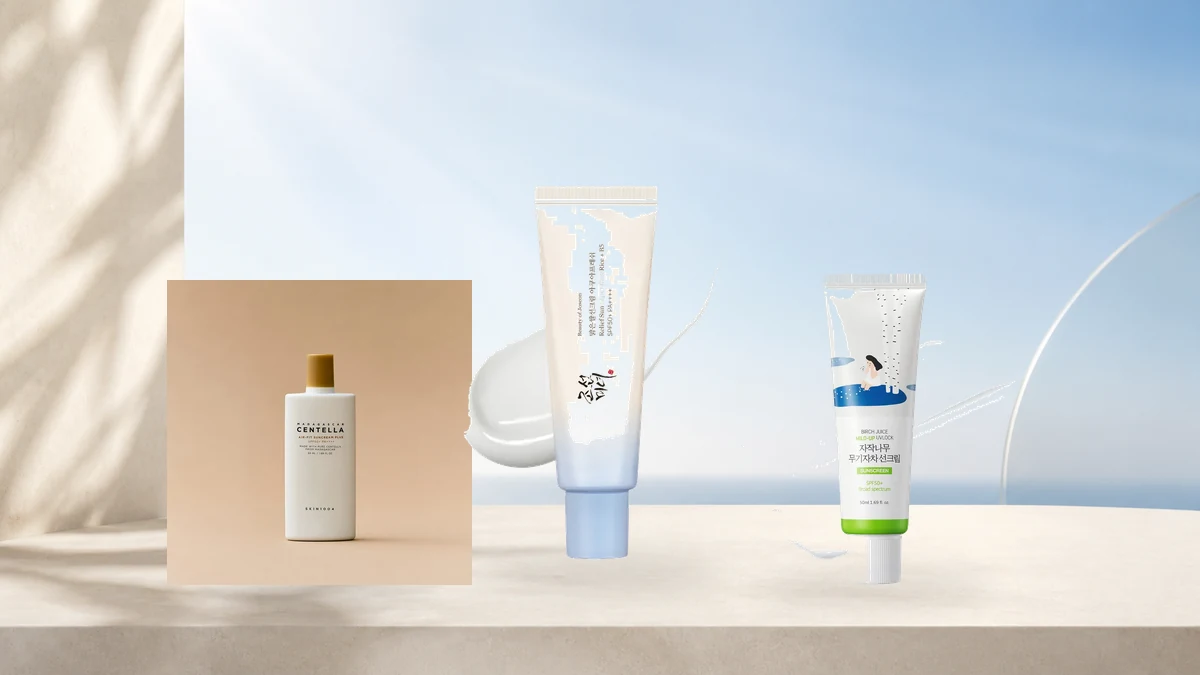
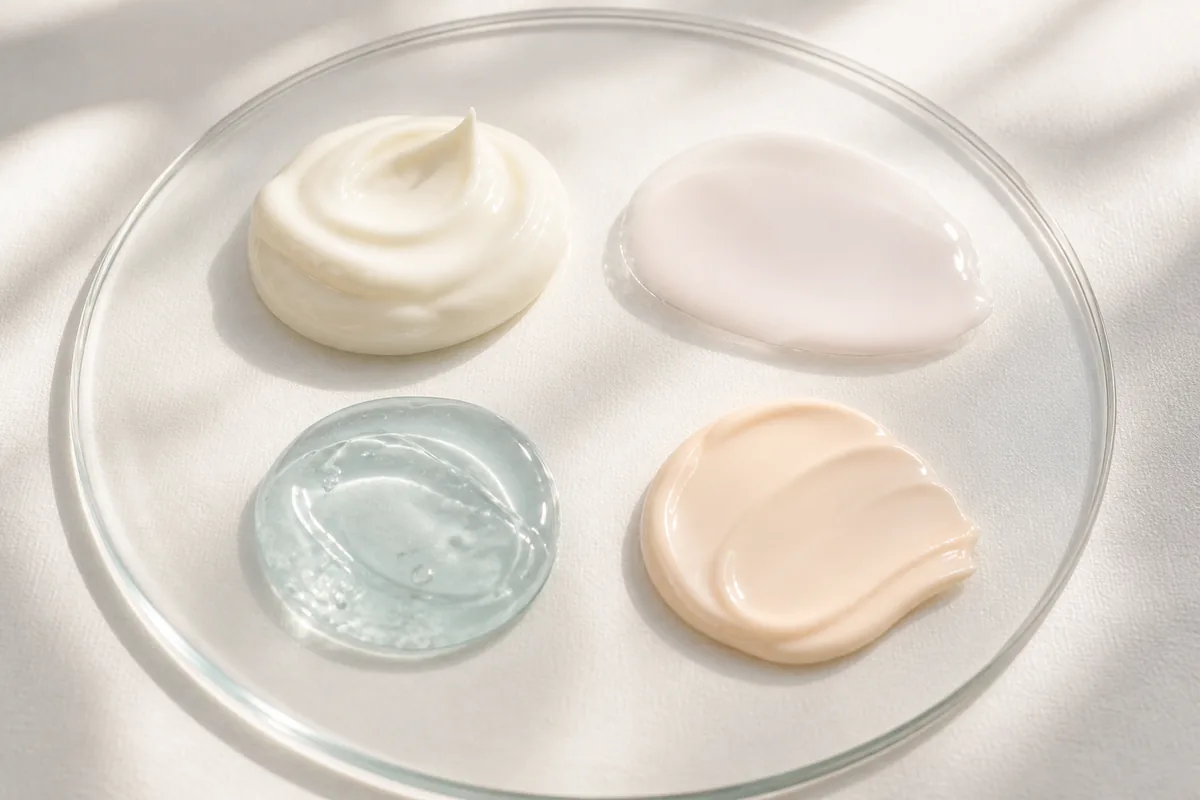
- Cream — richer finish, generally suited to normal-to-dry skin or drier climates/seasons.
- Essence or serum sunscreen — a Korean-sun-care hallmark; watery, fast-absorbing, layers easily under makeup.
- Gel — cooling, low-shine finish, popular for oily skin and hot weather.
- Stick — convenient for reapplication over makeup, touch-ups on the go, or targeted areas like the nose and cheekbones.
- Tone-up — includes a light color-correcting or brightening tint on top of UV protection; not a substitute for full-coverage makeup, but a step that can reduce the number of products layered on.
- Water-resistant — formulated to hold up better during sweating or water exposure for a limited time. No sunscreen is fully waterproof; water-resistant sunscreens are tested and rated for a specific duration (commonly 40 or 80 minutes) before reapplication is needed, per FDA labeling standards.
Everyday Use vs. Outdoor Activities
Sitting mostly indoors near windows or commuting briefly still means UV exposure, so a lightweight daily SPF is worth wearing even on low-sun-exposure days. For extended outdoor time
beach days, hikes, sports a higher SPF, a water-resistant formula,
and a real reapplication plan (not just one morning application) all matter more than they do for an average indoor day.
How to Apply and Reapply Sunscreen
Dermatology guidance from groups like the American Academy of Dermatology generally recommends applying sunscreen as the last step of a skincare routine, before makeup,
and using enough product to cover all exposed skin many people apply noticeably less than the amount used in official testing, which reduces real-world protection.
Reapplication roughly every two hours during direct sun exposure, and immediately after swimming or heavy sweating, is the standard recommendation.
A setting spray or powder sunscreen can help with reapplication over makeup, though a stick or cushion is often easier for a full, even layer.
How KBeautyVibe Compares Sunscreen Rankings
Different Korean-beauty platforms measure “popularity” in genuinely different ways, and it’s worth knowing what you’re actually looking at before treating a ranking as a universal verdict:
- Olive Young Global — rankings from Olive Young’s international store.
- Olive Young Korea — rankings from Olive Young’s Korean store.
- Hwahae — Korean consumer rankings and reviews.
- Amazon — Best Sellers–sorted K-beauty results, excluding sponsored products.
A product that ranks well on one platform isn’t automatically ranked the same way on another
a Best Sellers list reflects purchase and sales behavior on that specific storefront, while a reviews-based ranking reflects user ratings and sentiment.
KBeautyVibe keeps these platforms separate rather than blending them into one score, so you can see where a product is actually popular and why,
instead of a single number that hides the difference.
FAQ
Is a higher SPF always better?
Not necessarily. The jump in protection between SPF 30 and SPF 50 is smaller than the numbers suggest, and no SPF replaces reapplication.
Choosing a texture you’ll actually reapply consistently often matters more than chasing the highest SPF number available.
Do I need sunscreen indoors?
UVA rays can pass through window glass, so some daily exposure happens even indoors near windows.
Many people still choose a light daily sunscreen for this reason,
though how essential it is can depend on how much time you spend near windows or how far you are from them.
Can I use body sunscreen on my face?
You can,
but face-specific formulas are generally designed with lighter textures and are less likely to clog facial pores or feel heavy under makeup.
Body sunscreen is usually a better fit for larger areas like arms and legs.
Will a mineral sunscreen definitely feel gentler than a chemical one?
Not always.
Formula quality, additional ingredients, and your own skin’s sensitivities matter more than the filter category alone.
Some people tolerate certain chemical formulas better than certain mineral ones, and vice versa.
What does “no white cast” actually mean?
It’s a description of how a specific formula tends to look on many users, not a guarantee.
Skin tone, application amount, and how the product is blended can all affect whether any cast is visible.
Editor’s Note
Sunscreen recommendations here are based on publicly available product information, formula categories, and how different platforms structure their own rankings — not on in-house clinical testing.
Skin reacts individually, so what performs well for reviewers or ranks highly on a given platform may not be the right match for your skin or routine.
When in doubt about a medical or dermatological concern, a licensed dermatologist is the right resource, not a shopping guide.
Sources and Further Reading
- U.S. Food and Drug Administration (FDA) — Sunscreen: How to Help Protect Your Skin from the Sun
- American Academy of Dermatology (AAD) — Sunscreen FAQs
- Korea Ministry of Food and Drug Safety (MFDS) — cosmetic UV filter and labeling regulations
Current ranking signals
These are the Korean sunscreens currently ranking highest across KBeautyVibe’s tracked sources – positions update automatically and are not frozen into this guide.
Related Guides
Sources & Methodology
Product positions and prices shown here come from the current source-labelled ranking page for the relevant category. Olive Young Global is presented as a global storefront signal, not global customer demand. Rankings and prices can change. Read our methodology.